
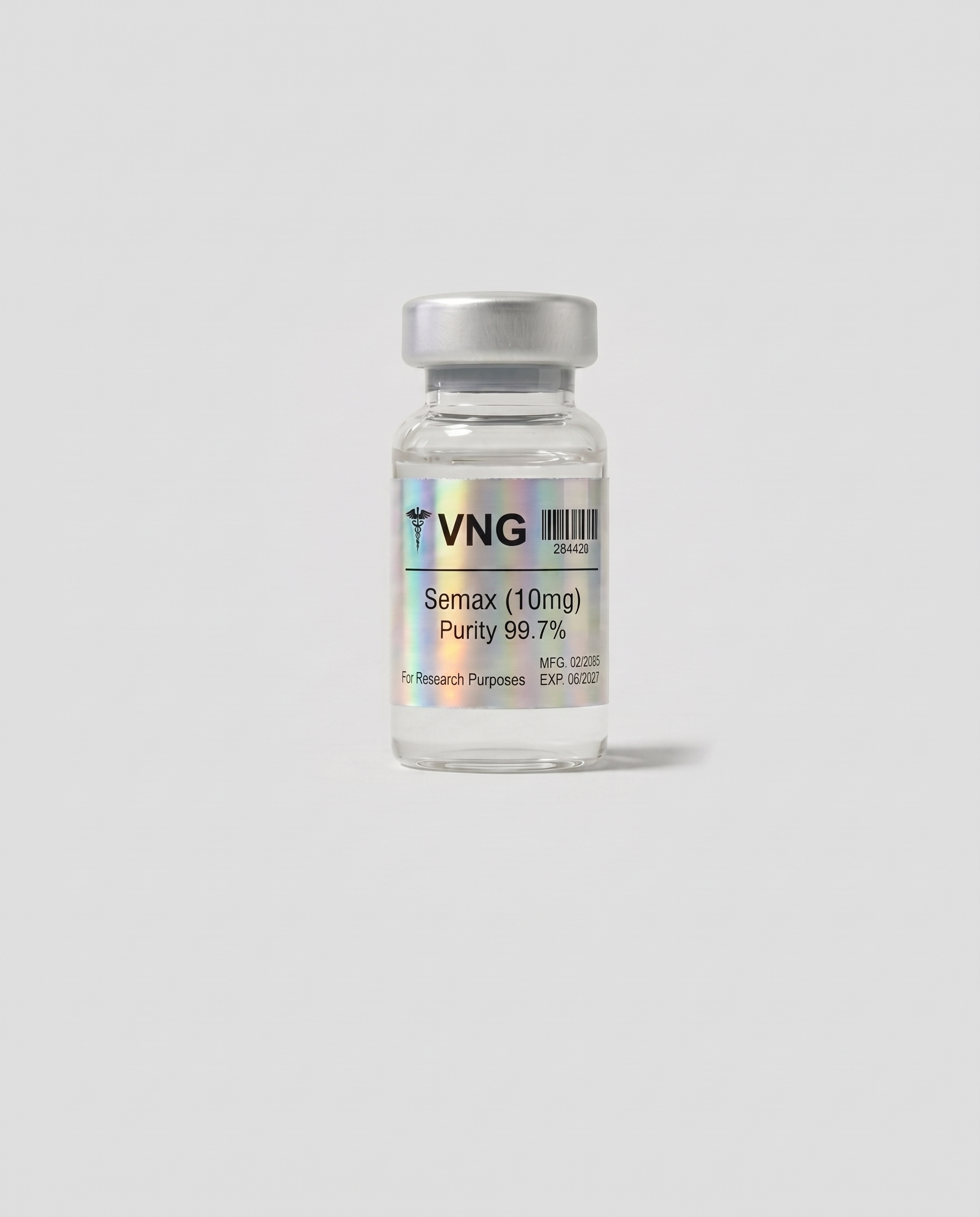
For research & educational purposes only. This article is a neutral, procedural reference for laboratory / in-vitro research handling — not medical advice or a usage recommendation. These materials are not for human or animal consumption.
On this page
What Semax is
Semax is a synthetic heptapeptide developed in Russia, built from a short fragment of the natural hormone ACTH with a small added 'tail' that helps it resist being broken down. In its home country it has been studied and used as a nootropic and neuroprotective agent, though most of the published research is preclinical and Russian-based. It is supplied as an analytical-grade reference material for laboratory research.
Where it comes from
Semax was developed in the 1980s and 1990s by researchers at the Russian Academy of Sciences, who were looking for a stable, brain-active peptide based on the natural hormone ACTH. They took a short neuroactive stretch of ACTH — the ACTH(4-7) fragment, which acts on the nervous system without the hormone's steroid-releasing effects — and attached a small proline-glycine-proline 'tail.' That tail makes the resulting heptapeptide far more resistant to the enzymes that would otherwise chop it apart quickly, giving researchers a longer-lasting tool. In Russia it has since been studied and used clinically as a nootropic and neuroprotective agent.
What it does — in plain terms
Semax comes from a piece of ACTH — a hormone best known for controlling stress steroids — but the specific fragment it copies has lost that steroid-releasing job and instead acts on the brain. Researchers study it as a neuroprotective and 'nootropic' (cognition-supporting) peptide: in animal models it appears to help nerve cells survive stresses like poor blood flow, and it has been examined for effects on learning, attention, and the brain's own signaling. A large share of this work comes out of Russian laboratories, and it remains almost entirely animal and cell research.
How it works
Semax is a fragment-derived peptide, and the fragment it comes from matters. Full ACTH triggers the release of stress steroids, but the short ACTH(4-7) piece Semax is built around has shed that hormonal role and instead acts as a signal inside the nervous system. This is why researchers regard it as a neuromodulator rather than a stress hormone — it appears to change how nerve cells respond to challenge rather than driving the body's steroid response.
Much of the mechanistic work looks at what Semax does inside stressed brain tissue. In rodent stroke (ischemia) models, studies describe it shifting the activity of many genes and proteins at once — including ones tied to the immune response and to blood vessels — which researchers read as part of how it appears to protect brain tissue starved of blood. Separate lab work has also found the peptide binds copper ions tightly and can shield cells from metal-driven toxicity, another angle on its protective behavior.
More recent animal studies have started to pin down specific molecular targets, such as a gene in the opioid-receptor system linked to recovery after nerve injury. Taken together the picture is of a broadly 'protective and pro-recovery' peptide rather than one with a single clean switch — but it is worth stressing that essentially all of this is animal and cell research, much of it from Russian laboratories, so it describes how Semax behaves in models rather than proven effects in people.
What the research shows
Semax has a long history of study and clinical use in Russia, but for an English-speaking researcher the published evidence base is narrower than that reputation suggests: it is overwhelmingly preclinical — animal and cell models — and much of it comes from a small number of laboratories. With that firmly in mind, here is what several of the key studies actually report.
- BMC Genomics, 2014 — found that Semax shifted the expression of genes tied to the immune and vascular systems in rat brain affected by focal ischemia (an animal stroke model).
- Journal of Inorganic Biochemistry, 2015 — showed in cell-based work that this ACTH(4-10) analog binds copper(II) ions with high affinity and can protect cells against metal-induced toxicity.
- International Journal of Molecular Sciences, 2021 — used a brain protein-expression profile to confirm a protective effect of the ACTH(4-7)PGP peptide (Semax) in a rat model of cerebral ischemia-reperfusion.
- British Journal of Pharmacology, 2025 — reported that Semax acts on the mu-opioid receptor gene Oprm1 to promote functional recovery after spinal cord injury in mice.
- Acta Naturae, 2025 — examined Semax and a derivative for correcting pathological impairments in an animal model of Alzheimer's disease.
What Semax is studied for
Neuroprotection in stroke models. The most-developed research area. In rodent models of ischemia (interrupted blood flow to the brain), Semax is studied for shifting gene and protein activity in ways that appear to protect the affected tissue.
Cognition and nootropic effects. Semax is studied in Russia as a nootropic, and animal work examines effects on learning, attention, and behavior — though rigorous independent human data are limited.
Recovery after nerve injury. Newer animal studies look at whether Semax can aid functional recovery after damage such as spinal cord injury, including work pointing to specific molecular targets in the opioid-receptor system.
Neurodegeneration models. Researchers have also begun testing Semax and its derivatives in animal models of Alzheimer's disease, examining whether it can blunt the pathological changes seen in those models.
Storage & handling
As a lyophilized (freeze-dried) powder, Semax reference material keeps best cold and dark — refrigerated for the short term, or frozen for longer storage. Once reconstituted with bacteriostatic water it should be kept refrigerated at roughly 2-8 °C, protected from light, and shielded from repeated freeze-thaw cycles, which small peptides tolerate poorly. See the reconstitution reference below for the concentration math.
Plain-language explanations describe what researchers study — not what any product does for a person, and not medical advice. Every material here is sold for laboratory research use only and is not for human or animal use.
Reconstitution reference
Standard laboratory reconstitution volumes for Semax, from the VNG Reconstitution Sheet. See the full reconstitution guide for the method and concentration math.
| Product | Vial | Bacteriostatic water | Resulting concentration |
|---|---|---|---|
| Semax | 10 mg | 2 mL | 5 mg/mL |
Frequently asked questions
What is Semax?
Semax is a synthetic heptapeptide derived from a short, neuroactive fragment of the hormone ACTH, with an added proline-glycine-proline tail that makes it more stable. It is studied mainly for neuroprotection and cognition, and is supplied here as an analytical-grade reference material for laboratory research use only.
Where does Semax come from?
It was developed in Russia in the 1980s-1990s at the Russian Academy of Sciences and has been studied and used there as a nootropic and neuroprotective agent. Much of the published research originates from Russian laboratories.
Is Semax supported by strong human clinical trials?
Not by the standard most Western researchers would expect. The evidence provided here is entirely preclinical — animal and cell studies — and while Semax has a history of clinical use in Russia, large, independent, well-controlled human trials are lacking. That is an important caveat.
What does the ACTH connection mean?
Semax copies a fragment of ACTH that acts on the nervous system but does not trigger the stress-steroid release the full hormone causes. So despite the hormonal origin, researchers study it as a brain-signaling peptide rather than a stress hormone.
How should the reference material be stored?
Keep the lyophilized powder cold and dark, and refrigerate it after reconstitution with bacteriostatic water while avoiding repeated freeze-thaw cycles. See the storage note and reconstitution guide for specifics.
Published research
A selection of peer-reviewed and clinical literature indexed on PubMed. Provided so qualified researchers can locate the primary sources — inclusion here is not a claim about any product or outcome.
- Animal studyBMC genomics · 2014
The peptide Semax affects the expression of genes related to the immune and vascular systems in rat brain focal ischemia
View on PubMed - Cell studyJournal of inorganic biochemistry · 2015
Semax, an ACTH4-10 peptide analog with high affinity for copper(II) ion and protective ability against metal-induced cell toxicity
View on PubMed - Animal studyInternational journal of molecular sciences · 2021
Brain protein expression profile confirms the protective effect of the ACTH(4-7)PGP peptide (Semax) in a rat model of cerebral ischemia-reperfusion
View on PubMed - Animal studyBritish journal of pharmacology · 2025
Semax peptide targets the mu-opioid receptor gene Oprm1 to promote functional recovery after spinal cord injury in mice
View on PubMed - Animal studyActa naturae · 2025
The potential of the peptide drug Semax and its derivative for correcting pathological impairments in an animal model of Alzheimer's disease
View on PubMed
References & resources
Related reference materials
VNG Research Team
VNG Labs supplies analytical-grade reference materials with lot-matched Certificates of Analysis. Our write-ups are neutral, source-cited references for qualified and independent researchers.
More from LearnResearch use only. Not for human consumption or veterinary use. Sold exclusively to qualified researchers for in vitro and laboratory research. These statements have not been evaluated by the FDA. Not intended to diagnose, treat, cure, or prevent any disease. Refrigerate upon receipt. Keep in dark environment.