
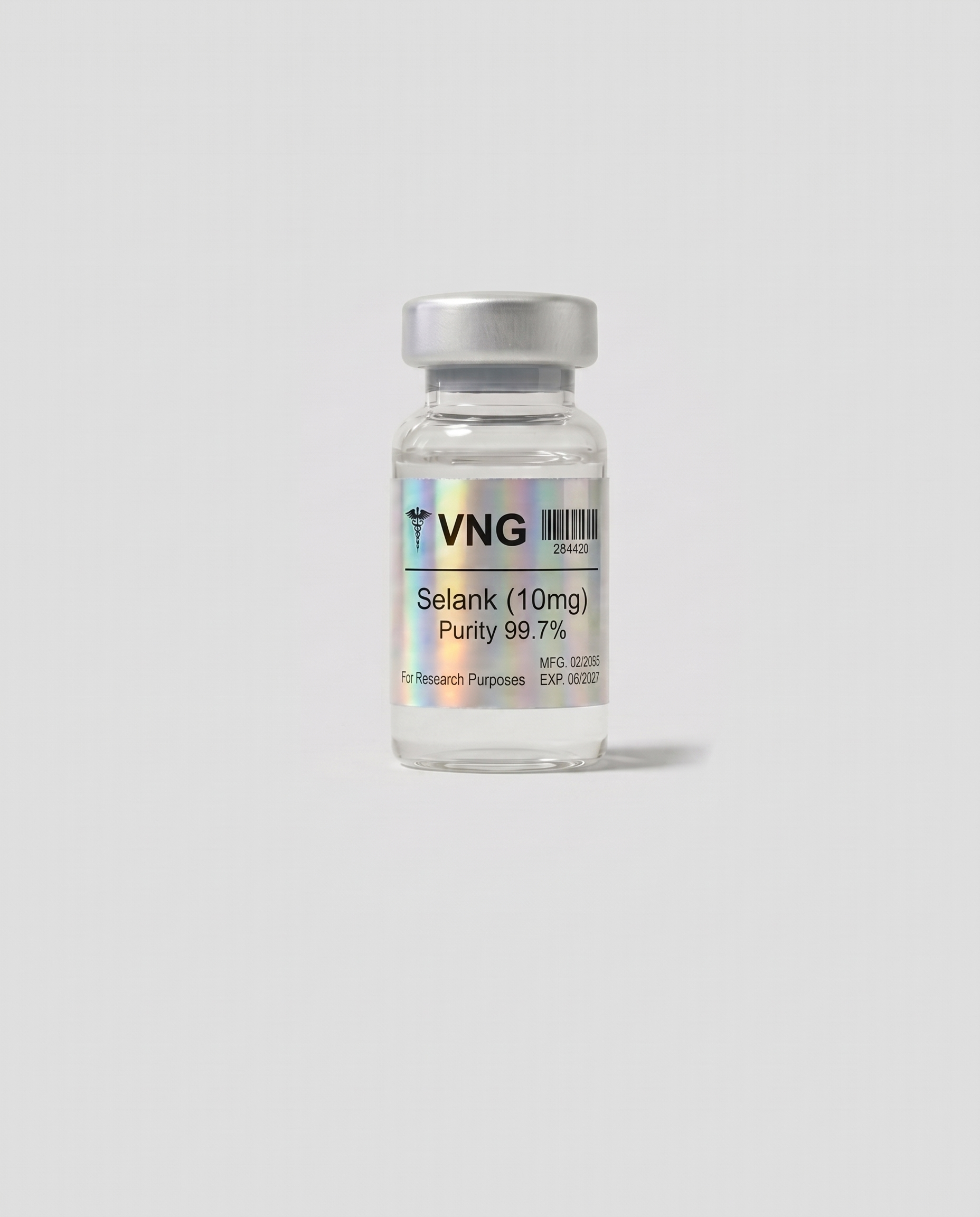
For research & educational purposes only. This article is a neutral, procedural reference for laboratory / in-vitro research handling — not medical advice or a usage recommendation. These materials are not for human or animal consumption.
On this page
What Selank is
Selank is a synthetic heptapeptide developed in Russia as a stable analog of tuftsin, a small natural peptide involved in immune signaling. It is studied mainly as an anxiolytic (anti-anxiety) and nootropic agent, though — as with its cousin Semax — most of the published evidence is preclinical and comes from Russian laboratories. It is supplied as an analytical-grade reference material for laboratory research.
Where it comes from
Selank was designed in Russia at the Institute of Molecular Genetics of the Russian Academy of Sciences as a stable relative of tuftsin — a natural four-amino-acid peptide, cut from an antibody, that helps coordinate immune cells. On its own, tuftsin breaks down almost immediately in the body. Researchers extended it with a proline-glycine-proline tail to create the heptapeptide Selank, which resists those enzymes and lasts long enough to study. Somewhat unexpectedly for an immune-derived molecule, its most-studied effects turned out to be on the brain, and in Russia it has been studied and used as an anti-anxiety agent.
What it does — in plain terms
Selank is built from tuftsin, a tiny peptide the body produces as part of immune defense, with an added tail that makes it far more stable. Despite that immune origin, the research spotlight is on the brain: in animal models Selank is studied for calming anxiety-like behavior, and it appears to work partly through the GABA system — the same 'braking' network that anti-anxiety drugs act on — as well as by influencing brain growth factors and mood-related signaling. Most of this remains animal and cell research.
How it works
Selank's design is the key to understanding it. Its parent, tuftsin, is a natural immune-signaling peptide that the body breaks down within minutes; by adding a proline-glycine-proline tail, researchers created a version stable enough to actually study. That shared backbone means Selank keeps some of tuftsin's immune-modulating character while also acting on the nervous system.
The nervous-system effect researchers focus on most is anxiety. Several studies point to the GABA system — the brain's main 'calming' or braking network, and the same system targeted by benzodiazepine anti-anxiety drugs. Work in animals has described Selank changing the activity of genes involved in GABA signaling, and other studies found it strengthened the anxiety-reducing effect of the benzodiazepine diazepam under chronic-stress conditions, hinting that the two act on overlapping pathways.
A second thread connects Selank to brain-derived neurotrophic factor (BDNF), a growth factor important for learning and memory; in animal work it has been reported to influence BDNF levels and guard against memory problems. As with Semax, the honest bottom line is that this is almost entirely animal and cell research, much of it Russian, describing how the peptide behaves in models rather than confirmed effects in people.
What the research shows
Like Semax, Selank carries a reputation from decades of Russian study and clinical use, but the peer-reviewed evidence available to an outside researcher is limited and heavily preclinical, concentrated in a handful of laboratories and animal models. Keeping that context in mind, here is what several of the key studies actually report.
- Protein and Peptide Letters, 2018 — reviewed the molecular basis of the heptapeptide Selank's biological activity as a peptide-based anxiolytic.
- Behavioural Neurology, 2017 — found that Selank strengthened the anxiety-reducing effect of the benzodiazepine diazepam in rats under unpredictable chronic mild stress.
- Frontiers in Pharmacology, 2016 — reported that Selank administration altered the expression of several genes involved in GABAergic neurotransmission — the brain's main calming system.
- Bulletin of Experimental Biology and Medicine, 2019 — showed in rats that Selank protected against ethanol-induced memory impairment, in association with changes in BDNF (a brain growth factor) content.
- Current Medicinal Chemistry, 2017 — reviewed the properties and analogs of tuftsin — the natural immune peptide that Selank is derived from — rather than Selank itself.
What Selank is studied for
Anxiety-like behavior. The flagship research area. In rodent models Selank is studied as an anxiolytic, including work showing it can enhance the calming effect of standard benzodiazepine compounds under chronic stress.
The GABA system. Mechanistic studies focus on GABAergic neurotransmission — the brain's principal inhibitory, or 'calming,' network — with animal work showing Selank shifts the expression of genes tied to that system.
Memory and brain growth factors. Other animal studies look at learning and memory, reporting that Selank can guard against certain memory impairments while influencing levels of the growth factor BDNF.
Immune signaling. Because it descends from the immune peptide tuftsin, Selank is also of interest for immune-modulating effects, one of the threads that carries over from its parent molecule.
Storage & handling
As a lyophilized (freeze-dried) powder, Selank reference material is most stable kept cold and dark — refrigerated for short holds, or frozen for longer storage. Once reconstituted with bacteriostatic water it should be refrigerated at roughly 2-8 °C, kept out of light, and protected from repeated freeze-thaw cycles, which degrade small peptides. See the reconstitution reference below for the concentration math.
Plain-language explanations describe what researchers study — not what any product does for a person, and not medical advice. Every material here is sold for laboratory research use only and is not for human or animal use.
Reconstitution reference
Standard laboratory reconstitution volumes for Selank, from the VNG Reconstitution Sheet. See the full reconstitution guide for the method and concentration math.
| Product | Vial | Bacteriostatic water | Resulting concentration |
|---|---|---|---|
| Selank | 10 mg | 2 mL | 5 mg/mL |
Frequently asked questions
What is Selank?
Selank is a synthetic heptapeptide based on tuftsin, a natural immune-signaling peptide, with an added tail that makes it much more stable. It is studied mainly for anxiety-related behavior and cognition, and is supplied here as an analytical-grade reference material for laboratory research use only.
How is Selank thought to work?
In animal studies it appears to act partly through the GABA system — the brain's main calming network, also targeted by benzodiazepine anti-anxiety drugs — and to influence brain growth factors such as BDNF. Its origin in the immune peptide tuftsin also gives it immune-modulating properties.
Is Selank supported by strong human clinical trials?
Not by rigorous international standards. The evidence here is preclinical — animal and cell research — and although Selank has been studied and used clinically in Russia, large, independent, well-controlled human trials are lacking. That is an important caveat when interpreting the findings.
How is Selank related to Semax?
They are cousins: both are stable, Russian-developed heptapeptides made by adding a proline-glycine-proline tail to a short natural peptide. Semax comes from a fragment of ACTH and is studied mainly for neuroprotection, while Selank comes from tuftsin and is studied mainly for anxiety.
How should the reference material be stored?
Keep the lyophilized powder cold and dark, and refrigerate it after reconstitution with bacteriostatic water while avoiding repeated freeze-thaw cycles. See the storage note and reconstitution guide for details.
Published research
A selection of peer-reviewed and clinical literature indexed on PubMed. Provided so qualified researchers can locate the primary sources — inclusion here is not a claim about any product or outcome.
- Peer-reviewed studyProtein and peptide letters · 2018
Peptide-based anxiolytics: the molecular aspects of heptapeptide Selank biological activity
View on PubMed - Animal studyBehavioural neurology · 2017
Peptide Selank enhances the effect of diazepam in reducing anxiety in unpredictable chronic mild stress conditions in rats
View on PubMed - Peer-reviewed studyFrontiers in pharmacology · 2016
Selank administration affects the expression of some genes involved in GABAergic neurotransmission
View on PubMed - Animal studyBulletin of experimental biology and medicine · 2019
Selank, a peptide analogue of tuftsin, protects against ethanol-induced memory impairment by regulating BDNF content in rats
View on PubMed - Peer-reviewed reviewCurrent medicinal chemistry · 2017
Tuftsin - properties and analogs
View on PubMed
References & resources
Related reference materials
VNG Research Team
VNG Labs supplies analytical-grade reference materials with lot-matched Certificates of Analysis. Our write-ups are neutral, source-cited references for qualified and independent researchers.
More from LearnResearch use only. Not for human consumption or veterinary use. Sold exclusively to qualified researchers for in vitro and laboratory research. These statements have not been evaluated by the FDA. Not intended to diagnose, treat, cure, or prevent any disease. Refrigerate upon receipt. Keep in dark environment.