
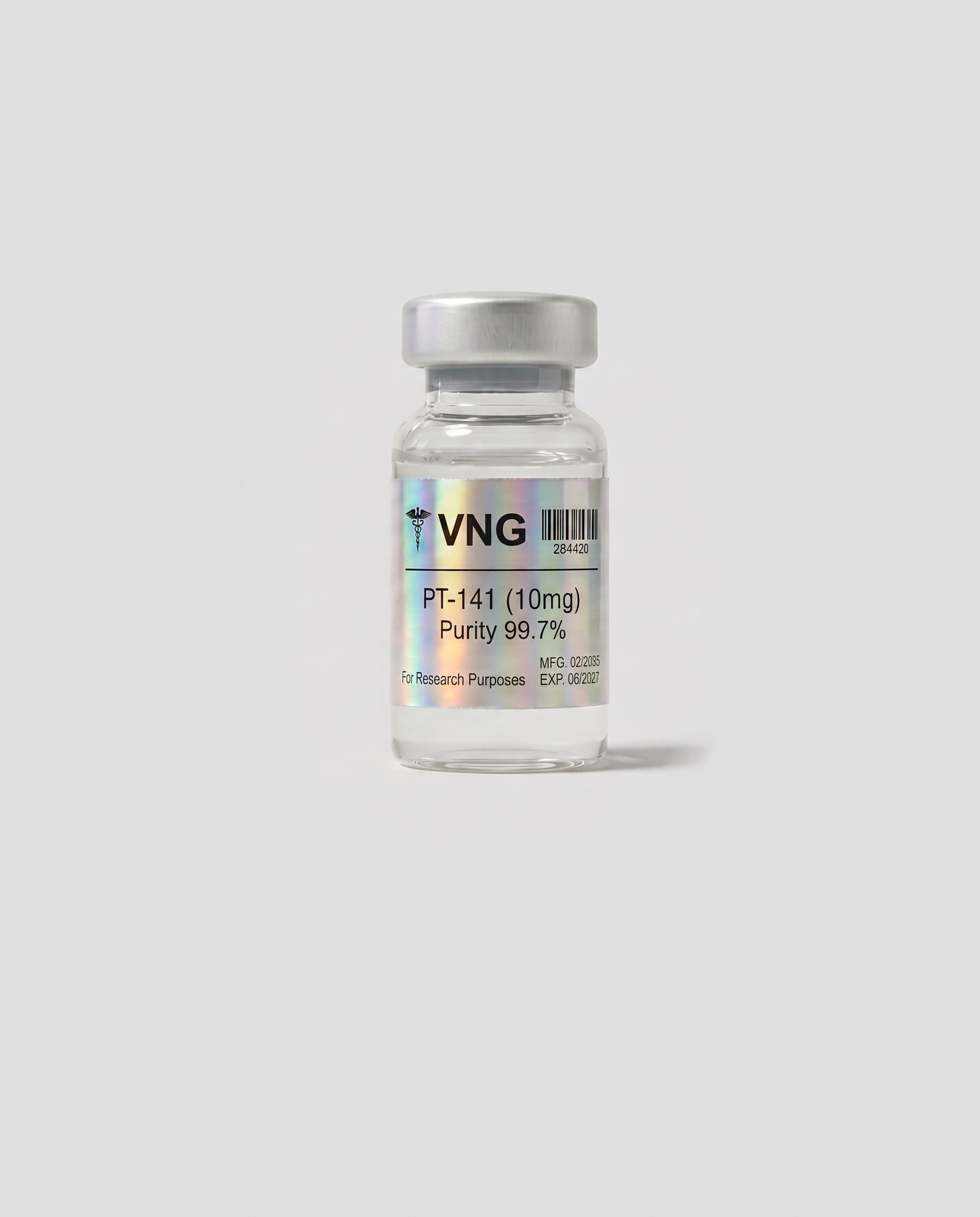
For research & educational purposes only. This article is a neutral, procedural reference for laboratory / in-vitro research handling — not medical advice or a usage recommendation. These materials are not for human or animal consumption.
On this page
What PT-141 is
PT-141 (bremelanotide) is a lab-made peptide that acts on the brain's melanocortin receptors rather than on the vascular system most sexual-function compounds target. As the prescription drug Vyleesi it is FDA-approved for hypoactive sexual desire disorder (HSDD) in premenopausal women, though its trial effects have been described as modest and are openly debated. It is supplied as an analytical-grade reference material for laboratory research.
Where it comes from
PT-141, known generically as bremelanotide, grew out of research on Melanotan II — a melanocortin peptide originally explored as a synthetic tanning agent. Investigators noticed that Melanotan II produced unexpected effects on sexual arousal, and bremelanotide was developed as its active derivative to pursue that observation deliberately. Chemically it is a small cyclic peptide analog of the natural hormone alpha-MSH. Unlike most of this catalogue, it went the whole distance through human trials and, in 2019, was approved by the FDA as the prescription drug Vyleesi for hypoactive sexual desire disorder in premenopausal women.
What it does — in plain terms
Most compounds aimed at sexual function work on blood flow. PT-141 is different: it acts on the brain. It is a melanocortin-receptor agonist, meaning it switches on a family of receptors (especially MC4R) involved in how the nervous system processes sexual motivation and arousal — a 'central' rather than 'plumbing' route. Researchers study it to understand how the melanocortin system shapes sexual behavior. It is worth being clear-eyed: in its human trials for low sexual desire, the measured effects were small and their real-world meaning has been openly questioned by reviewers.
How it works
PT-141 works on the melanocortin system — a family of five receptors (MC1R through MC5R) that the body's natural melanocortin hormones, such as alpha-MSH, normally act on. Bremelanotide is a broad melanocortin agonist, but the receptor that matters for its studied use is MC4R, which is concentrated in the brain. This is the key distinction from the familiar erectile-dysfunction drugs: those act on blood vessels in the periphery, whereas PT-141 acts centrally, in the nervous system, on the circuits thought to govern sexual motivation itself.
In the brain, activating MC4R (and related melanocortin receptors) in regions such as the hypothalamus is thought to feed into the neural pathways that process sexual desire and arousal. Review articles on its neurobiology lay out this central mechanism as the leading explanation for how a melanocortin peptide could influence desire rather than simply the mechanics of arousal — but they also stress that the full circuitry in humans is not completely mapped.
It is important to be honest about the size of the effect. Even where the mechanism is plausible, the downstream result measured in people has been modest, and independent analyses have questioned how meaningful the changes really are. The mechanism is a genuine and active area of melanocortin research; the clinical payoff is real but small and contested — both things are true at once.
What the research shows
PT-141 is unusual in this collection because it is not only a research peptide but an approved drug, so its evidence base includes full human Phase 3 trials rather than mostly animal work. That makes honesty about the results especially important: the trials met their formal targets, but the actual effect sizes were small, and a notable strand of the published literature — including a re-analysis and a pointed critique — argues those benefits are marginal and their real-world value questionable. Here is what the key papers report.
- Drugs, 2019 — summarized bremelanotide's path to its first regulatory approval as a melanocortin-receptor agonist for hypoactive sexual desire disorder in premenopausal women.
- Obstetrics & Gynecology, 2019 — reported two randomized Phase 3 trials of bremelanotide in premenopausal women with hypoactive sexual desire disorder, which met their primary endpoints but with modest effect sizes.
- CNS Spectrums, 2022 — reviewed the neurobiology of bremelanotide, laying out how central melanocortin (MC4R) signaling is thought to influence sexual desire.
- Journal of Sex Research, 2021 — re-analyzed the Phase 3 bremelanotide trial data and concluded the measured benefits for desire were small.
- Journal of Sex Research, 2024 — argued, in a pointed critique, that bremelanotide's effects are small and its meaningful outcomes questionable.
What PT-141 is studied for
Melanocortin (MC4R) receptor signaling. PT-141 is a melanocortin agonist, so it is used to study how activating these receptors — MC4R in particular — in the central nervous system influences behavior.
Central control of sexual motivation. Unlike blood-flow compounds, PT-141 acts in the brain, which makes it a tool for researching how the nervous system, rather than the vascular system, shapes sexual desire and arousal.
Hypoactive sexual desire disorder (HSDD). As the drug bremelanotide, it is FDA-approved for HSDD in premenopausal women; the condition and the Phase 3 trial data form a defined research context, with the important caveat that the measured effects were modest and are debated.
Evidence appraisal and trial critique. PT-141 has also become a case study in reading modest clinical results honestly, with published re-analyses and critiques weighing how meaningful its benefits actually are.
Storage & handling
As a lyophilized (freeze-dried) powder, PT-141 reference material is most stable kept cold and dark — refrigerated for short holds, or frozen for longer storage. Once reconstituted with bacteriostatic water it should be refrigerated at roughly 2-8 °C, protected from light, and kept away from repeated freeze-thaw cycles, which can degrade a small peptide. Prepare only what a given experiment needs and store the rest cold. See the reconstitution reference below for the concentration math.
Plain-language explanations describe what researchers study — not what any product does for a person, and not medical advice. Every material here is sold for laboratory research use only and is not for human or animal use.
Reconstitution reference
Standard laboratory reconstitution volumes for PT-141, from the VNG Reconstitution Sheet. See the full reconstitution guide for the method and concentration math.
| Product | Vial | Bacteriostatic water | Resulting concentration |
|---|---|---|---|
| PT-141 | 10 mg | 1 mL | 10 mg/mL |
Frequently asked questions
What is PT-141?
PT-141 (bremelanotide) is a small cyclic peptide that acts as an agonist at the body's melanocortin receptors. It is derived from the melanocortin peptide Melanotan II and works on the brain rather than on blood vessels. It is supplied here as an analytical-grade reference material for laboratory research use only.
Is PT-141 an FDA-approved drug?
Yes. As bremelanotide, sold under the brand name Vyleesi, it received FDA approval in 2019 for hypoactive sexual desire disorder (HSDD) in premenopausal women. That approval is a matter of public record. The material supplied here, however, is a reference material for laboratory research use only, not a medicine.
How is PT-141 different from erectile-dysfunction drugs?
The route is different. Erectile-dysfunction drugs such as PDE5 inhibitors act on blood flow in the periphery, whereas PT-141 acts centrally, on melanocortin receptors in the brain that are involved in sexual motivation. That central mechanism is the main reason it is of interest in neuroscience research.
How strong are PT-141's effects?
Honestly, modest. Its Phase 3 trials met their formal endpoints, but the actual effect sizes were small, and independent re-analyses and critiques have questioned how meaningful the benefits are in practice. It should not be thought of as a dramatic 'enhancer'; the honest picture is a real but small and debated effect.
What do researchers study PT-141 for?
Chiefly the melanocortin system and the central control of sexual behavior — how activating MC4R and related receptors in the brain influences motivation and arousal. Because it is an approved drug with published trial data, it is also studied as a case in appraising modest clinical evidence. This remains laboratory research, and nothing here is medical advice.
Published research
A selection of peer-reviewed and clinical literature indexed on PubMed. Provided so qualified researchers can locate the primary sources — inclusion here is not a claim about any product or outcome.
- Peer-reviewed reviewDrugs · 2019
Bremelanotide: first approval
View on PubMed - Human clinical trialObstetrics and gynecology · 2019
Bremelanotide for the treatment of hypoactive sexual desire disorder: two randomized phase 3 trials
View on PubMed - Peer-reviewed reviewCNS spectrums · 2022
The neurobiology of bremelanotide for the treatment of hypoactive sexual desire disorder in premenopausal women
View on PubMed - Meta-analysisJournal of sex research · 2021
Re-analyzing phase III bremelanotide trials for hypoactive sexual desire disorder in women
View on PubMed - Peer-reviewed reviewJournal of sex research · 2024
Small effects, questionable outcomes: bremelanotide for hypoactive sexual desire disorder
View on PubMed
References & resources
Related reference materials
VNG Research Team
VNG Labs supplies analytical-grade reference materials with lot-matched Certificates of Analysis. Our write-ups are neutral, source-cited references for qualified and independent researchers.
More from LearnResearch use only. Not for human consumption or veterinary use. Sold exclusively to qualified researchers for in vitro and laboratory research. These statements have not been evaluated by the FDA. Not intended to diagnose, treat, cure, or prevent any disease. Refrigerate upon receipt. Keep in dark environment.