
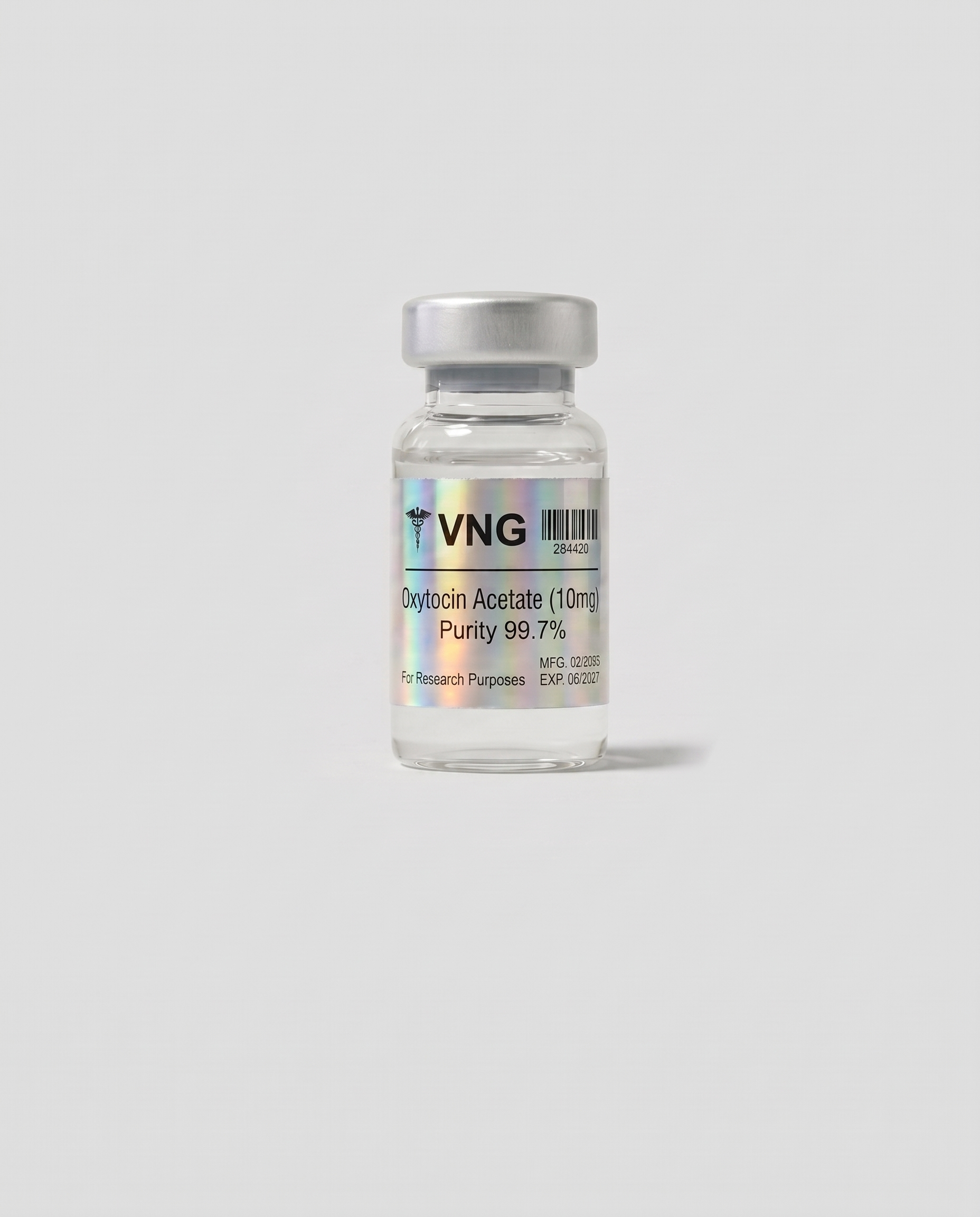
For research & educational purposes only. This article is a neutral, procedural reference for laboratory / in-vitro research handling — not medical advice or a usage recommendation. These materials are not for human or animal consumption.
On this page
What Oxytocin Acetate is
Oxytocin is a natural nine-amino-acid hormone made in the hypothalamus and released by the pituitary; the acetate form is simply the peptide supplied as its acetate salt. Long known for its roles in labor and lactation, it is now studied largely for how its receptor shapes social behavior. It is supplied as an analytical-grade reference material for laboratory research.
Where it comes from
Oxytocin has a landmark place in biochemistry. Its contracting effect on the uterus was first observed by Henry Dale in 1906, and its name comes from Greek words meaning 'quick birth.' In 1953 Vincent du Vigneaud worked out its nine-amino-acid sequence and chemically synthesized it — making oxytocin the first polypeptide hormone ever built in the lab, an achievement that earned the 1955 Nobel Prize in Chemistry. Structurally it is a small ring closed by a sulfur-sulfur bridge, differing from the related hormone vasopressin by only two amino acids.
What it does — in plain terms
Oxytocin is best known as the hormone behind two bodily events — the contractions of childbirth and the 'let-down' of milk during nursing. But it is also a messenger in the brain, where it acts on the oxytocin receptor to influence social and emotional behavior: bonding, recognition, and how animals respond to one another. That second, brain-side role is where most current research sits. It is worth stressing that findings — especially the headline-grabbing ones about trust and social connection in humans — are hedged and often debated, so the science is best read cautiously.
How it works
Oxytocin acts through a single main receptor, the oxytocin receptor (OXTR), a G-protein-coupled receptor found both around the body and throughout the brain. In the periphery its effects are the classic ones: it makes the smooth muscle of the uterus contract during labor and drives the 'let-down' reflex that ejects milk during nursing. These are the actions for which it was first characterized, and they remain the clearest part of its biology.
Inside the brain, oxytocin behaves as a neuromodulator rather than a simple on-switch. Acting on oxytocin receptors distributed across social and emotional circuits, it appears to tune how animals process social information — recognition, bonding, and responses to others. Review articles describe it as shaping the salience of social cues and contributing to neural plasticity, which is why it has become a central molecule in social-neuroscience research.
The honest caveat is large. Much of the excitement around oxytocin as a 'social' or even 'bonding' hormone rests on animal work and on human studies whose findings have proven difficult to reproduce consistently. Reviewers go back and forth on how far the animal picture translates to people, and even papers asking whether oxytocin is 'nature's medicine' are careful about the gap between promise and proof. It is a rich research subject, not a settled one.
What the research shows
The provided literature on oxytocin is almost entirely review material, which fits a molecule that has been studied for over a century yet remains genuinely unsettled in its behavioral role. The peripheral biology — uterine contraction and milk let-down — is well established; the brain-and-behavior story is where reviewers disagree, and reproducibility of the human social findings is an open problem. With that framing, here is what these reviews actually cover.
- Physiological Reviews, 2018 — reviewed the oxytocin receptor in depth, tracing the path from its intracellular signaling to its effects on behavior.
- Annual Review of Neuroscience, 2021 — surveyed how oxytocin shapes neural plasticity and social behavior, framing it as a modulator of social circuits.
- Physiological Reviews, 2001 — laid out the structure, function, and regulation of the oxytocin receptor system, a foundational reference for the field.
- Endocrinology, 2022 — reviewed oxytocin and the related hormone vasopressin in social behavior, connecting neural circuits to possible clinical directions.
- Pharmacological Reviews, 2020 — asked whether oxytocin deserves its reputation as 'nature's medicine,' weighing its broad effects against the strength of the evidence.
What Oxytocin Acetate is studied for
Oxytocin-receptor (OXTR) signaling. Oxytocin acts through a single main receptor, so it is a standard tool for studying how that receptor signals inside cells and across tissues.
Social and bonding behavior. Most current interest is in the brain, where oxytocin is studied as a modulator of social recognition, bonding, and how animals respond to one another — with the caveat that human findings are contested.
Neural plasticity and social circuits. Reviews describe oxytocin tuning the salience of social cues and contributing to plasticity in social-emotional circuits, making it a focus of social-neuroscience research.
Classic reproductive physiology. Its longest-established roles — triggering uterine contraction in labor and the milk let-down reflex in nursing — remain a reference point and are the clearest part of its biology.
Storage & handling
As a lyophilized (freeze-dried) powder, oxytocin acetate reference material is most stable kept cold and dark — refrigerated for short holds, or frozen for longer storage. Oxytocin is a small, disulfide-bridged peptide and is sensitive to heat and oxidation, so once reconstituted with bacteriostatic water it should be refrigerated at roughly 2-8 °C, shielded from light, and kept away from repeated freeze-thaw cycles. Prepare fresh and use promptly. See the reconstitution reference below for the concentration math.
Plain-language explanations describe what researchers study — not what any product does for a person, and not medical advice. Every material here is sold for laboratory research use only and is not for human or animal use.
Reconstitution reference
Standard laboratory reconstitution volumes for Oxytocin Acetate, from the VNG Reconstitution Sheet. See the full reconstitution guide for the method and concentration math.
| Product | Vial | Bacteriostatic water | Resulting concentration |
|---|---|---|---|
| Oxytocin Acetate | 10 mg | 10 mL | 1 mg/mL |
Frequently asked questions
What is oxytocin acetate?
Oxytocin is a natural cyclic nine-amino-acid hormone made in the hypothalamus and released by the pituitary gland; 'acetate' simply refers to the acetate-salt form in which the peptide is commonly supplied. It is supplied here as an analytical-grade reference material for laboratory research use only.
What does oxytocin do?
It has two well-established peripheral jobs — causing the uterus to contract during labor and triggering the milk let-down reflex during nursing. In the brain it acts as a neuromodulator on social and emotional circuits, which is the main focus of current research. The brain-and-behavior effects are far less settled than the reproductive ones.
Is oxytocin really the 'love' or 'bonding' hormone?
That popular label overstates what the science shows. Oxytocin does influence social behavior in animal models, but many of the human findings about trust and bonding have been hard to reproduce, and reviewers actively debate how far the animal results apply to people. It is best understood as an important but unsettled research subject, not a proven 'bonding' agent.
Is oxytocin research mostly done in humans?
The clearest mechanistic work is in cells and animal models, while much of the human social-behavior literature is mixed and debated. The reference reviews here cover both, but findings in animals do not necessarily carry over to people, and this material is for laboratory use only.
How does oxytocin relate to vasopressin?
They are close chemical cousins — oxytocin differs from the hormone vasopressin by just two amino acids, and the two systems overlap in the brain's social circuits. Several reviews study them together, which is why vasopressin often appears alongside oxytocin in social-behavior research.
Published research
A selection of peer-reviewed and clinical literature indexed on PubMed. Provided so qualified researchers can locate the primary sources — inclusion here is not a claim about any product or outcome.
- Peer-reviewed reviewPhysiological reviews · 2018
The oxytocin receptor: from intracellular signaling to behavior
View on PubMed - Peer-reviewed reviewAnnual review of neuroscience · 2021
Oxytocin, neural plasticity, and social behavior
View on PubMed - Peer-reviewed reviewPhysiological reviews · 2001
The oxytocin receptor system: structure, function, and regulation
View on PubMed - Peer-reviewed reviewEndocrinology · 2022
Oxytocin, vasopressin, and social behavior: from neural circuits to clinical opportunities
View on PubMed - Peer-reviewed reviewPharmacological reviews · 2020
Is oxytocin 'nature's medicine'?
View on PubMed
References & resources
Related reference materials
VNG Research Team
VNG Labs supplies analytical-grade reference materials with lot-matched Certificates of Analysis. Our write-ups are neutral, source-cited references for qualified and independent researchers.
More from LearnResearch use only. Not for human consumption or veterinary use. Sold exclusively to qualified researchers for in vitro and laboratory research. These statements have not been evaluated by the FDA. Not intended to diagnose, treat, cure, or prevent any disease. Refrigerate upon receipt. Keep in dark environment.