
For research & educational purposes only. This article is a neutral, procedural reference for laboratory / in-vitro research handling — not medical advice or a usage recommendation. These materials are not for human or animal consumption.
On this page
What ARA-290 is
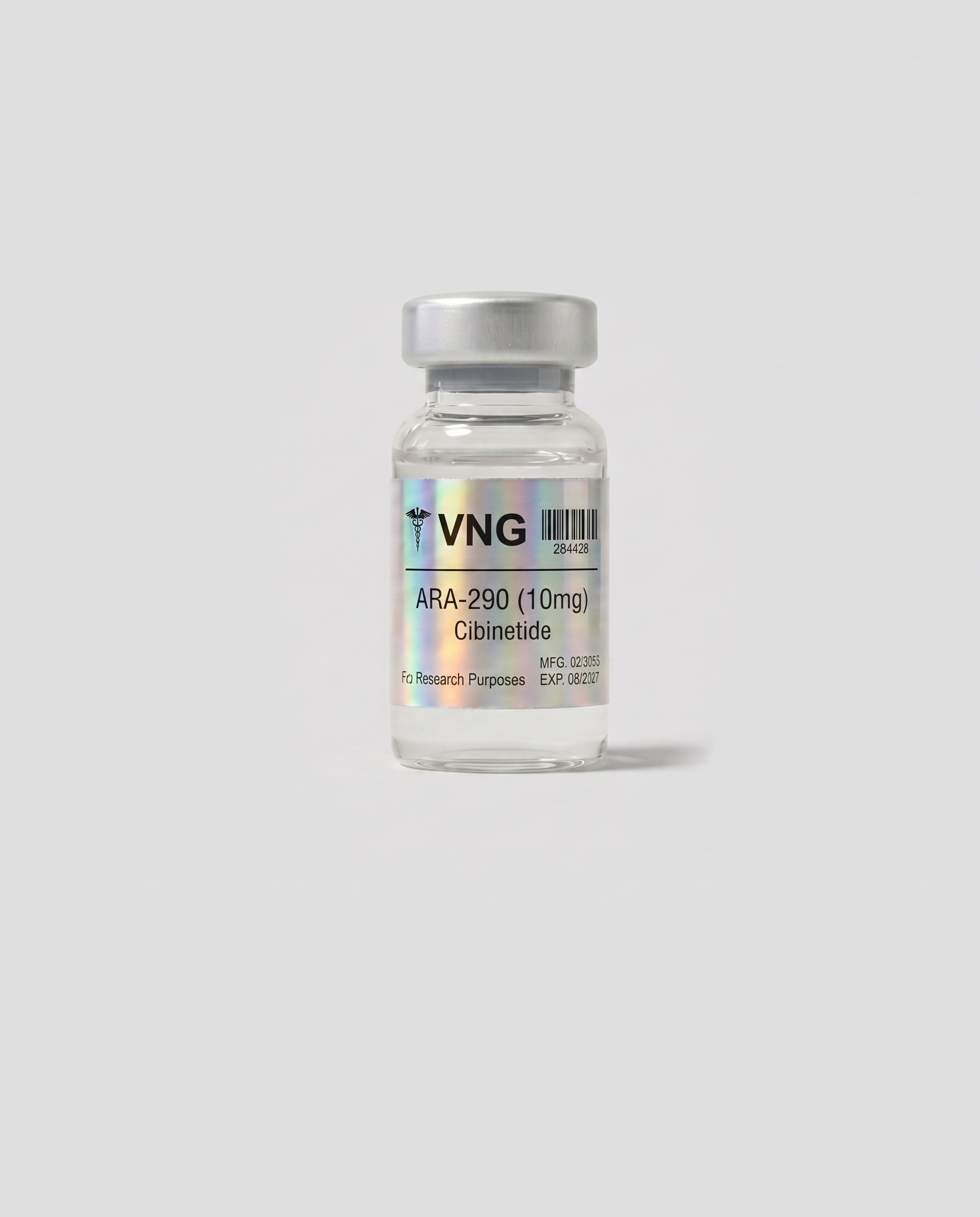
ARA-290 (also called cibinetide) is a small 11-amino-acid peptide engineered from a region of erythropoietin (EPO), the hormone that signals the body to make red blood cells. Unlike EPO, it is 'non-erythropoietic': it switches on EPO's separate tissue-protective and anti-inflammatory signaling without raising red-blood-cell counts. It is supplied as an analytical-grade reference material for laboratory research.
Where it comes from
ARA-290 grew out of a key discovery about erythropoietin (EPO): the hormone's ability to protect injured tissue is separate from its ability to make red blood cells, and the two are carried by different parts of the molecule. Researchers mapped the tissue-protective activity to a specific region of EPO's structure that faces away from the classic EPO receptor, then engineered a short 11-amino-acid peptide, ARA-290 or cibinetide, that reproduces this protective signaling on its own, without stimulating red-blood-cell production.
What it does — in plain terms
Erythropoietin has two jobs: the well-known one is telling bone marrow to produce red blood cells, but it also quietly protects and repairs stressed tissue. Those jobs run through different receptors. ARA-290 was engineered to trigger only the second, the tissue-protective and anti-inflammatory pathway, by acting on what researchers call the innate repair receptor. Because it leaves the red-blood-cell pathway alone, it avoids EPO's blood-related risks. That is why labs study it around nerve repair, neuropathic pain, and calming an over-active immune response, and, unusually for a research peptide, it has been examined in early human trials.
How it works
To understand ARA-290, it helps to know that erythropoietin does two very different things. The job it is named for is telling bone marrow to make red blood cells. But EPO also acts as a local tissue-protective and repair signal when cells are stressed or injured, and this second role runs through a different receptor. ARA-290 was built to activate only that second pathway.
That pathway centers on what researchers call the innate repair receptor, understood as a partnership between the EPO receptor and a second component (the beta-common receptor, CD131). Activating it appears to calm innate immune cells, lower inflammatory signaling, and support nerve and tissue repair. Because ARA-290 largely leaves the classical EPO receptor alone, it does not drive up red-blood-cell counts, sidestepping the clotting and blood-pressure risks that limit EPO itself.
Downstream, the research describes two notable effects: dampening of innate immune cell activity, seen in an experimental colitis model, and modulation of pain signaling through the TRPV1 channel. Unusually for a peptide in this category, ARA-290 has also been carried into human phase 2 trials, which gives it a layer of clinical evidence that most research peptides lack, though that evidence is still early-stage.
What the research shows
ARA-290 stands apart from most research peptides in one important way: it has actually been examined in human clinical trials, not just cell and animal studies. Small phase 2 trials have looked at it in small-fiber neuropathy (in sarcoidosis and in type 2 diabetes) and in diabetic macular edema, alongside mechanistic work on pain and inflammation. The honest caveat is that these human trials are early-phase and preliminary, encouraging on some symptom and nerve measures but in need of larger, confirmatory studies. With that context, here is what the published work actually reports.
- Molecular Medicine, 2013 — reported, in a human clinical trial, that ARA-290 improved symptoms and increased corneal nerve-fiber density in patients with sarcoidosis-associated small-fiber nerve loss.
- Molecular Medicine, 2015 — found, in patients with type 2 diabetes, that ARA-290 (a non-erythropoietic peptide engineered from erythropoietin) improved metabolic control and neuropathic symptoms.
- Peptides, 2016 — examined how ARA-290 reduces pathophysiological pain signaling by acting on the TRPV1 channel in laboratory models.
- Scientific Reports, 2017 — showed that cibinetide dampened innate immune cell activity and improved the course of experimental colitis in an animal model.
- Journal of Clinical Medicine, 2020 — tested cibinetide in a phase 2 clinical trial in patients with diabetic macular edema, a fluid-related swelling of the retina.
What ARA-290 is studied for
Small-fiber neuropathy and nerve repair. The most-developed area, with human phase 2 trials in sarcoidosis- and diabetes-associated small-fiber nerve loss reporting improved symptoms and measures of nerve-fiber density.
Neuropathic pain signaling. Laboratory work examines how ARA-290 modulates pain pathways, including action on the TRPV1 channel, a key sensor in pathological pain.
Inflammation and innate immunity. Through the innate repair receptor, ARA-290 is studied for calming innate immune cell activity, for example improving the course of experimental colitis in an animal model.
Retinal (eye) disease. A phase 2 trial examined cibinetide in diabetic macular edema, extending the tissue-protective research to the retina.
Storage & handling
As a lyophilized (freeze-dried) powder, ARA-290 reference material is best kept cold and dark, refrigerated for short-term storage or frozen for longer holds. Unlike most peptides in this catalog, it is typically reconstituted with phosphate-buffered saline (PBS) rather than bacteriostatic water; once in solution it should be refrigerated at roughly 2-8 °C, protected from light, and shielded from repeated freeze-thaw cycles. See the reconstitution reference below for the concentration math.
Plain-language explanations describe what researchers study — not what any product does for a person, and not medical advice. Every material here is sold for laboratory research use only and is not for human or animal use.
Reconstitution reference
Standard laboratory reconstitution volumes for ARA-290, from the VNG Reconstitution Sheet. See the full reconstitution guide for the method and concentration math.
| Product | Vial | Bacteriostatic water | Resulting concentration |
|---|---|---|---|
| ARA-290 (Cibinetide) | 10 mg | 0.5 mL — Phosphate-Buffered Saline (NOT bacteriostatic water) | 20 mg/mL |
Frequently asked questions
What is ARA-290?
ARA-290, also called cibinetide, is an 11-amino-acid peptide engineered from a tissue-protective region of erythropoietin (EPO). It is 'non-erythropoietic,' meaning it does not stimulate red-blood-cell production. It is supplied here as an analytical-grade reference material for laboratory research use only.
How is ARA-290 different from EPO?
EPO both makes red blood cells and protects stressed tissue, through different receptors. ARA-290 was designed to activate only the tissue-protective, anti-inflammatory pathway, the innate repair receptor, without raising red-blood-cell counts, which avoids the blood-related risks associated with EPO.
Does ARA-290 have human clinical trials?
Yes, which is unusual for this category. It has been examined in small phase 2 trials in small-fiber neuropathy (in sarcoidosis and type 2 diabetes) and in diabetic macular edema. These are early-phase studies, however, and the results are preliminary and await larger confirmation.
Why is ARA-290 reconstituted with PBS instead of bacteriostatic water?
ARA-290 reference material is typically prepared in phosphate-buffered saline (PBS) rather than bacteriostatic water, following supplier guidance for its solubility and stability. Always follow the product's own reconstitution reference.
How is ARA-290 supplied and handled?
It ships as a lyophilized powder and is reconstituted in the laboratory with phosphate-buffered saline (PBS). It should be kept cold and dark and protected from freeze-thaw cycles. It is intended for laboratory research use only, not for human or veterinary use.
Published research
A selection of peer-reviewed and clinical literature indexed on PubMed. Provided so qualified researchers can locate the primary sources — inclusion here is not a claim about any product or outcome.
- Human clinical trialMolecular medicine (Cambridge, Mass.) · 2013
ARA 290 improves symptoms in patients with sarcoidosis-associated small nerve fiber loss and increases corneal nerve fiber density
View on PubMed - Human clinical trialMolecular medicine (Cambridge, Mass.) · 2015
ARA 290, a nonerythropoietic peptide engineered from erythropoietin, improves metabolic control and neuropathic symptoms in patients with type 2 diabetes
View on PubMed - Peer-reviewed studyPeptides · 2016
ARA 290 relieves pathophysiological pain by targeting the TRPV1 channel
View on PubMed - Animal studyScientific reports · 2017
Cibinetide dampens innate immune cell functions, ameliorating the course of experimental colitis
View on PubMed - Human clinical trialJournal of clinical medicine · 2020
A phase 2 clinical trial on the use of cibinetide for the treatment of diabetic macular edema
View on PubMed
References & resources
Related reference materials
VNG Research Team
VNG Labs supplies analytical-grade reference materials with lot-matched Certificates of Analysis. Our write-ups are neutral, source-cited references for qualified and independent researchers.
More from LearnResearch use only. Not for human consumption or veterinary use. Sold exclusively to qualified researchers for in vitro and laboratory research. These statements have not been evaluated by the FDA. Not intended to diagnose, treat, cure, or prevent any disease. Refrigerate upon receipt. Keep in dark environment.